Craft
The difference between a printed imitation of concrete and concrete itself is not visible in a photograph. It is visible in a room, and it begins in the workshop.
Colour, mixed rather than applied
Pigment is introduced into the body of the material, not onto its face. Tone therefore exists throughout the thickness of the tile: a chipped edge shows the same colour as the surface, and the palette reads as mineral rather than painted. It is also why colour is discussed as a range rather than a single value — a hand-mixed batch has a natural breadth, and that breadth is what gives a finished wall its depth.
The mould as a drawing
Every geometry in the collections begins as a mould — effectively a drawing translated into three dimensions. Relief depth, edge definition and the crispness of a chamfer are all decided here, long before a wall exists.
Time, which cannot be shortened
Casting and curing set their own pace. The material needs time to gain strength and stability, and no part of that schedule can be compressed without cost to the result. Lead times in handcraft are not inefficiency; they are the process being respected.
The last decision is human
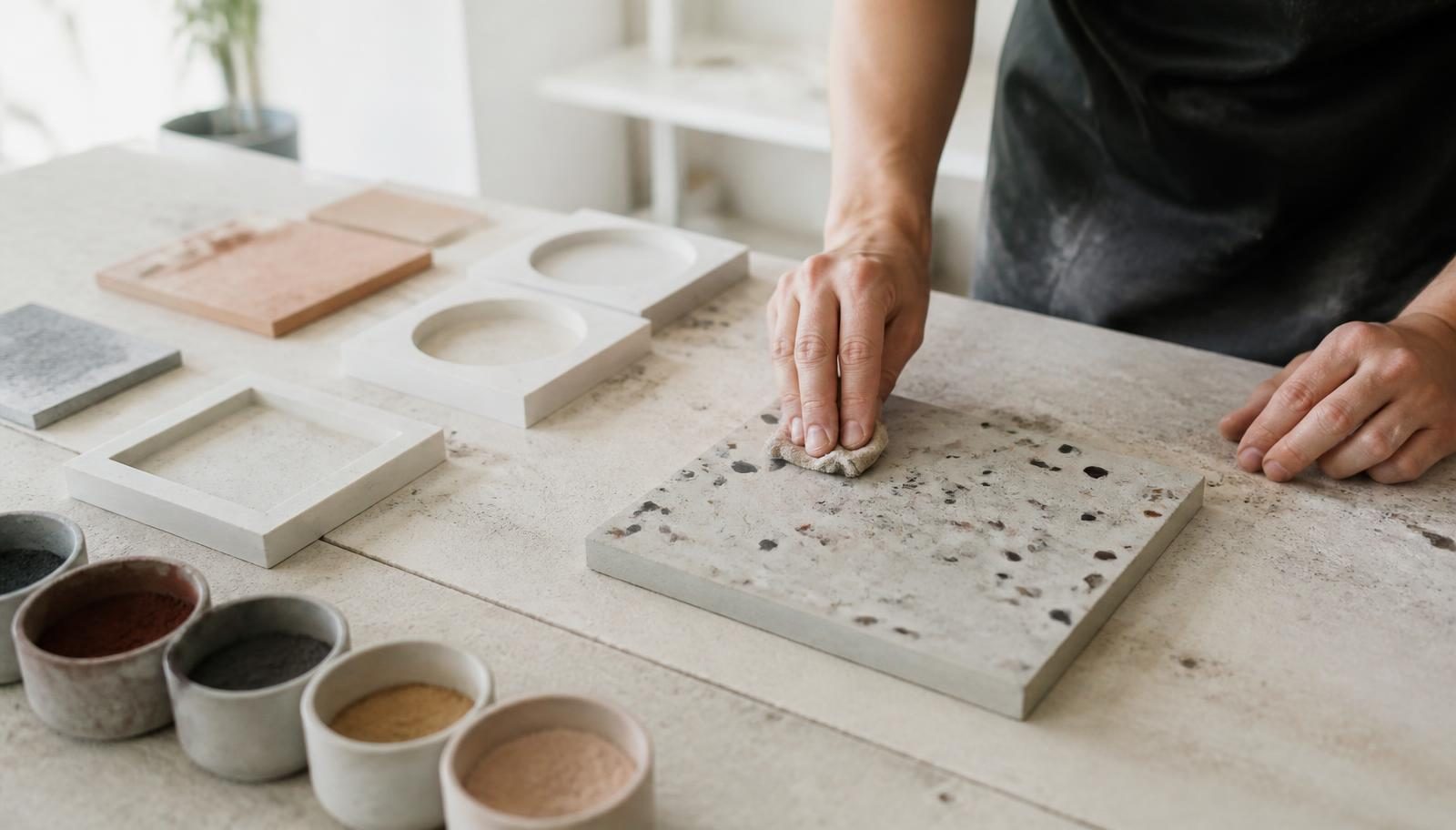
Finishing — smoothing, sandblasting, refining an edge — is done by hand, piece by piece. Each tile is assessed individually, and the judgement of the person holding it is the final quality control. It is slower than a production line, and it is the reason the surface carries a character a machine cannot reproduce.
When a designer asks why handmade matters, this is the honest answer: not nostalgia, but a level of control that only a human eye applies.
